Giveaways! None at the moment!
Check back soon!
TDF Staff Editor/Head Writer:
TDF Pamela
Regular Contributors:
Amanda
The Bibliomaniac
Emily
Lady T
LamoreVincera
Stacy B
Strangeness Abounds
WereGeek
To read more about us, head over and meet the geeks!
|
TDF Pamela, on August 8th, 2010 |
 Today we at TDF welcome Jon & Pamela Voelkel, authors of Middleworld! Our esteemed reviewer, WereGeek, asked them a few questions about their new novel, so give them a warm fangirl welcome!
WereGeek: Is the tourist hot pepper soup something you invented for the story or does that sort of thing really happen on tours? If it happens in real life, have either of you tried the soup? Did you pass the test? ;)
J & P Voelkel: What usually happens on tours is that the locals prepare their fanciest food and the tourists turn up their noses at it and get a burger back at their hotel. So we thought it would be funny to turn the tables and have the locals play a trick on Max. It seemed kind of appropriate because the Maya are usually portrayed as somber, almost grim, people and all the Maya we’ve met have twinkling eyes and a mischievous sense of humor. So the soup incident was made up – but it was inspired by an episode from Jon’s childhood. His family were guests of honor at a village and they were served freshly severed goat testicle. Everyone sat around to watch them eat. Jon can still remember locking eyes with the goat. So no, we haven’t eaten the pepper soup. But we love spicy food and we used to eat a lot of very hot curries when we lived in London, so maybe we’d pass the test. I just hope we would have seen the funny side and not stomped off like Max did.
WereGeek: How did you come by your extensive knowledge of the Maya? I see on the back cover that Jon grew up in Central America. Did he learn directly from the natives or was it formal study and/or comprehensive research?
J & P Voelkel: All of the above. The book was certainly inspired by Jon’s experiences growing up in Latin America, but our knowledge of the Maya was hard won. We’ve read every just about every book ever published about the Maya; we’ve attended lectures, seminars, and conferences to hear archaeologists speak about their latest research; and we’ve traveled extensively with our children in Belize, Guatemala and Mexico. Jon even took a short course at Harvard on reading and writing Maya glyphs– that’s where he met the professor who now checks all our facts.
WereGeek: With which character would you most like to spend time and why?
J & P Voelkel: Jon would like to spend time with Lady Coco because she’s such good fun and she’d have so many entertaining stories about life in a Maya court. Pamela would like to spend time with Lola, the modern Maya girl, because the Maya are at such a crossroads right now. I’d want to know how she feels about Landa burning the Maya books, and the last five hundred years of repression, and where she feels the future lies for her people. I’d also like to know who she thinks should play her in the movie of Middleworld – if there ever is one!
WereGeek: What are your plans for the rest of the series and when will those books be out? Are they already written or in progress?
J & P Voelkel: There will be three books in the series. The Jaguar Stones, Book Two: The End of The World Club, is in its final editing stages and will be out on 28th December 2010. Book Three will follow one year later. We’re in the process of writing it at the moment – although we wrote the final paragraph long ago, so we know exactly where we’re headed.
WereGeek: Thanks for chatting with us today!
 TDF Pamela
The Discriminating Fangirl, who is more likely to answer to Pamela if you shout it at her, is the proud owner of an MA in English, focusing on children's/young adult literature and popular culture. Because of her ample free time thanks to being gainfully unemployed, she reads voraciously. She also loves geeky movies and tv shows, reads comic books as often as she can buy them, and when she's procrastinating, she enjoys playing video games. She can be contacted at t.d.fangirl @ gmail.com and followed on Twitter at the link below.
profile | twitter
TDF Pamela, on August 4th, 2010 |
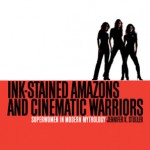 Ink-Stained Amazons and Cinematic Warriors: Superwomen in Modern Mythology by Jennifer K. Stuller
Buy It Now: on Amazon
Description: In this comprehensive history, inquiry, critique, and reference guide, Stuller argues that Superwomen, from Wonder Woman to Charlie’s Angels, are more than just love interests or sidekicks who stand by their supermen. She shows how the female hero in modern mythology has broken through the traditional boy’s club barrier to reveal the pivotal role of high-heeled crimefighters in popular culture. Chapter topics include love and compassion, spies and sexuality, daddy’s girls, and the complicated roles of superwomen who are also mothers. The book also includes a glossary of modern mythic women, as well as a foreword by acclaimed cultural commentator Roz Kaveney, author of Superheroes! Capes and Crusaders in Comics and Films.
This review is based on a free copy sent by the publisher.
TDF Pamela’s Review:
As I read Ink-Stained Amazons, I found myself relapsing into grad school behaviors. I read with a pen in hand, annotating and underlining constantly. And I found myself wishing that I’d had this book while I was still in school, because Stuller’s astute observations about tough women would have worked perfectly in the last paper I wrote, an examination of Zoe and Kaylee from Firefly as feminist heroes.
This isn’t the usual type of book that we review here at TDF, but on the other hand, it’s perfect. Most fangirls I’m friends with are big fans of strong female characters. I’ve even written about Hollywood’s version of the tough woman here, and no matter what your stand is on the matter, I think it’s important to be aware of the history and the issues at play when Hollywood and the comic book industry creates these superwomen.
Stuller’s book serves as an excellent introduction to superwomen throughout entertainment’s history, from Wonder Woman’s early comic book days to television’s relatively recent tough chicks, like Sydney Bristow and Dana Scully. Along with the useful history are a series of chapters about common issues in the portrayal of superwomen: redemption, collaboration, and compassion; superwomen and their fathers; and the maternal, filial, and mentoring relationships between women.
The idea of collaboration between women is of particular interest to me. Most of the male heroes we see are loners, but many of the women work within a team. Female superheroes are often members of teams, but you also have collaboration and female friendship featured prominently in some fandoms such as Xena and Buffy. I wrote about this in my Firefly paper: all four of the women of Serenity depend on each other as well as the male members of the crew as a family unit. As Stuller says, this kind of collaboration is common in the female hero “not because she is incapable of succeeding on her own, but because she is more successful when she recognizes, encourages, and utilizes the talents of others” (92). The crew of Serenity and the Scoobies stick together because they love each other, and they work better as a unit than they would as loners.
The third section of the book, “The Mythmakers,” deals not only with female creators of popular culture and modern mythology, but also with fans stepping up and demanding better portrayals of women, such as the creation of Project Girl Wonder and Gail Simone’s “Women in Refrigerators” observations.
This is a wonderful book if you’re looking to dive into analysis of female characters in pop culture. I’m actually thinking about expanding my Firefly paper thanks to Stuller’s fantastic book, though I haven’t the foggiest idea what I’d do with it, heh.

And now, enormous thanks to Jennifer for agreeing to a TDF interview! I actually had the pleasure of meeting her at San Diego Comic Con and chatting there, but alas! My iPhone ate the interview recording, and she was kind enough to agree to an email interview instead.
Read the interview after the jump! Continue reading Review: Ink-Stained Amazons… + Interview with author Jennifer K. Stuller
TDF Pamela
The Discriminating Fangirl, who is more likely to answer to Pamela if you shout it at her, is the proud owner of an MA in English, focusing on children's/young adult literature and popular culture. Because of her ample free time thanks to being gainfully unemployed, she reads voraciously. She also loves geeky movies and tv shows, reads comic books as often as she can buy them, and when she's procrastinating, she enjoys playing video games. She can be contacted at t.d.fangirl @ gmail.com and followed on Twitter at the link below.
profile | twitter
bibliomaniac, on December 1st, 2009 |

Welcome back to our interview with Alexander Gordon Smith, author of Lockdown: Escape from Furnace.
The justice and penal system portrayed in Lockdown are extremely interesting—and obviously, not very just. The state of the courts as they are shown seem to suggest that it is fairly easy to railroad an innocent man, while Furnace, the prison itself, seems to rely as much on an atmosphere of terror to confine the prisoners as the actual bars and guards with guns do. There have been a number of stories in the news in the last decade about people being unjustly convicted of crimes they didn’t commit, and being vindicated years or even decades later by new evidence coming to light. How much, if any, of the ideas behind Lockdown reflect those sorts of news stories?
I was thinking less about the news and more about my own worst fears. The thought of being convicted of a crime you didn’t commit, and spending your life in jail, is absolutely terrifying. When I was writing the book I wasn’t attempting to make any kind of political point or statement about the penal system in the UK or in the US. I wanted it to be a horror story, pure and simple. In fact the biggest problem I thought readers would have with the book was believing that a teenager could be sentenced to life without possibility of parole. It was only after I’d finished Lockdown that I read an article about teenagers in the States who had suffered this exact fate – literally locked away for the rest of their life. It is a tragic and distressing thought that, for some young people, there is no second chance (of course you can say the same about their victims…). I’m not sure if any of these individuals were wrongly convicted, but if so I can’t imagine a worse nightmare.
I don’t think the prison system is perfect, I don’t think there is as much focus on rehabilitation as there needs to be. And whilst real prisons aren’t full of monsters and mutant dogs, they do all seem to be based on an atmosphere of terror and violence. Surely the punishment in going to prison is losing your freedom, not being forced to live in a hell-on-Earth. But, like I say, I’m no expert on the matter and would never pretend to be. Part of what I wanted to show was that the label of “criminal” isn’t so clean cut as most people think. Alex is a criminal, and he’s not a nice guy to start with, but he’s not a killer. It’s only when he gets to Furnace that he is forced to commit the crimes that he was accused of, and only then to stay alive. Alex changes so much during the course of the series, for better and for worse, and maybe that’s the point – people can change, we need to help them change before it’s too late.
Lockdown is listed as a Young Adult novel, and deals with some fairly serious issues. There are people today who tend to believe that such topics are too intense for teenagers, and that young adults need to be prevented from reading works like that. For example, recently in Wisconsin, a group of conservative and religious parents and other adults tried to have the public library in West Bend, Wisconsin removed Francesca Lia Block’s novel Baby Be-Bop from the children’s section of the library because it dealt with a young man’s acceptance of his homosexuality. What do you think about people who would theoretically ban your book or other books they believe are “harmful” to teens?
I have no time for people who want to ban books because the content disagrees with their religious or moral beliefs. If everybody got to ban a book they didn’t approve of then the shelves would be empty of all but the most mundane and vacant material.
I think the desire to stop teenagers from reading a book like Baby Be-Bop (I’ve never read the book but it sounds wonderful) is disgusting. After all, this is the stage of life when kids need books the most because they help them understand what they’re going through, help them come to terms with the huge changes in their life, the way they see the world and the way the world sees them. Books also help them challenge the views that certain authorities have perhaps tried to impose upon them, they help kids see a bigger world and a bigger truth. Teenagers don’t always want to talk to people about their problems, and books are often the only form of guidance and counseling they can get – and they are a brilliant source of guidance and counseling!
Surely banning a book like Baby Be-Bop because it deals with a young man’s acceptance of his homosexuality is saying homosexuality is wrong, and that’s a terrible message to send out. If these protesters are worried that reading the book might change somebody’s sexuality then they really need to wake up! Books are powerful things, yes, but they’re powerful because they help people understand life, they help them make their own decisions.
Lockdown is a book for teenagers, and yes it has violence and death in it but there’s nothing that isn’t suitable for the audience it was written for. If anybody wanted to ban Lockdown because they thought it was harmful to teens then I’d tell them where to go. Lockdown is about friendship and trust and hope and freedom and self-discovery and love, like most books for teenagers, and that’s what these idiot protesters are blind to. They see the book’s cover, they don’t see its heart.
In Lockdown, the hell that is Furnace is shown as populated solely by the male half of the population: young prisoners and adult prison staff. Given that today’s gangs in the real world also have female members, is there a counterpart to Furnace filled with female prisoners? Obviously, having Furnace be co-ed just wouldn’t work.
I always knew that this was going to be an issue, and thought of various ways to try and get female characters into the book – not because I felt that I should, but because I enjoy writing female characters! Obviously Furnace couldn’t be a co-ed prison (explaining why can be the most awkward part of the events I do with children!) but, as you say, girls are capable of committing terrible crimes too. In the world of my books there is a counterpart to Furnace filled with female prisoners, although this isn’t explicitly stated in the novel. Fortunately for its inmates, however, this prison isn’t part of the same horrific plan as Furnace. There are reasons for this which will become apparent later on in the series. There will be female characters in the books, but not until book four – and I can’t say any more for fear of ruining the story!
Do you consider Lockdown to be science fiction or horror, or something else entirely?
I definitely think of the book as horror. As I mentioned earlier I was inspired to write the series by thinking about my own worst fears – I knew that if I wrote about what scared me then I would write convincingly. I love horror, it’s my favorite genre to read, watch and write. It’s partially about the scares, the adrenaline, the heart-pounding action, but mainly it’s about the mystery, the intrigue, the knowledge that something very wrong is happening that totally unravels your perception of reality. That’s what I love about horror – absolutely anything can happen. I wouldn’t really call Lockdown sci-fi at all, except for the fact that it’s set ever-so-slightly in the future (well, hopefully an alternative future). I wanted it to be grounded in a world which could be ours, a world which felt real, because that’s when horror works best – when it’s your own life you see crumbling into madness, when it’s your own reality tipping into the void. I love it!
Certain elements in Lockdown (I won’t say which ones, since I’m trying not to spoil the novel for those who haven’t read it yet) definitely seem to put the novel directly in the SF/horror genre. What are some of your favorite works in those genres? Are there more genre elements in Solitary and Death Sentence?
I read so much that it’s impossible to list my favorite authors and inspirations – usually every new book I read becomes my favorite because I get so caught up in the adventure or the mystery. As we’ve already talked about, I think Stephen King is a genius when it comes to creating a realistic world and populating it with believable characters then putting them all through hell. I also love Clive Barker, whose imagination seems boundless. I was delighted to have been compared to him in a review in the Financial Times earlier this year. I feel inspired by all of the classic horror writers – Poe, Lovecraft, Stoker, Shelley and far too many more to list here. I love Darren Shan too, who was a huge stylistic influence on Lockdown . And when it comes to creating an atmosphere of utter terror I don’t think anyone can beat Ramsey Campbell.
While I don’t necessarily want to become known as a horror writer, Escape from Furnace is definitely a horror series. And yes, it gets darker with each subsequent book! Saying that, each title in the series has a distinct feel – Solitary is more of a horror book, with perhaps an edge of sci-fi, whereas Death Sentence is an action book at its heart. I wanted to keep each title fresh and distinct – too much of the same thing, especially with horror, can be overwhelming!
Lockdown is currently available for Amazon.com’s Kindle e-book reader. Is it available in other formats? What do you think of e-books and e-book readers?
I haven’t quite made up my mind about e-books yet… In theory I love the idea that you can take your reader with you and instantly have access to pretty much every book on the planet. I mean how cool is that?! I’m a huge gadget freak and will no doubt buy a reader soon just to see what they’re like. Also, my house is full of books – I had to take several hundred to the charity shop the other day because there was just no room for them. It would be nice to have a book jukebox which could sit on my bedside table not taking up any space and not accumulating several inches of dust!
However, I love books as objects, I adore them – they way they look, feel, smell, sound, everything about them. I hope books never become extinct because they are beautiful things. I think what might happen is that people will gradually move over to readers for most books – bedtime reads, holiday books, academic texts and so on. But hopefully they’ll continue to buy the books that mean the most to them, their favorite books, the ones they’re proud to display on the shelves at home. I think we’ve all seen pictures of Neil Gaiman’s library – if I could have a space like that to store my books then I don’t think I’d ever need to buy a reader!
But it is extremely exciting to have my book available as an e-book because it makes it so easy for people to get hold of it and actually read it. You don’t have to visit a store, you can just click a link and it’s right there. As an author you’re always worried that people might not spot your book on the shelf and pick it up, you’re always worried that nobody will read it! So the easier it is for people to get hold of, the better – if your story is travelling the world digitally at the speed of light it can’t be a bad thing! The most important thing for me is that Lockdown is being read and being enjoyed – whether that’s on the printed page, a screen or as an audio book doesn’t really matter.
With the plethora of YA novels being adapted into films these days, would you like to see Lockdown made into a movie? If so, indulge us: what would be your dream cast? Who would you like to see play Alex and the other characters?
Having a film made of Lockdown would be a dream come true – I can’t think of anything I’d like more! However, if they made it scene-for-scene then it would probably have to be rated R! You can get away with more in a book, I think, because you let the reader’s imagination do so much of the work. It’s different in films. Well, certainly in modern films which seem to have forgotten that horror works best when you don’t see the object of your terror in full-blown CGI.
I wouldn’t know who to suggest for the cast. Part of me thinks it would work best with a cast that was utterly unknown, especially for the boys. That way their adventure, and their nightmare, would seem more real. I could see somebody like Shia LeBeouf playing Alex, though, because he plays the everyday kid-next-door role really well and that’s what Alex is – he’s every kid who could have taken a wrong turn. I’m a huge fan of the wire and could see Tristan Wilds as Donovan. As for the warden… I could picture Liam Neeson playing the role, he’s certainly got the right build and with a bit of make-up could really look the part of a man who may be the devil!
Film adaptations aren’t always great, but I think if you try to separate the experience from the book, see it as a totally different story, then it works best. I love movies, and it really would be the most amazing thing in the world to be able to go into the cinema and watch my story come to life on the big screen. Keep your fingers crossed!
It’s been great talking to you. Thank you so much for spending some time with us!
Thanks again for the chance to answer some questions on your fantastic blog!
 The Bibliomaniac
Ye olde author (emphasis on the OLD) likes the weird and the strange, which explains most of her friends. Married, with two daughters, she has earned a B.A. in Literature and a B.S. in Criminal Justice. Her interests include reading and writing (of course!), gardening, poetry, comic books, herbalism, chocolate, tea, mythology and fairy tales, comparative theology and alternative religions, Celtic and darkwave music, role-playing games and LARPing, horror movies, hiking and camping, SF conventions, and the martial arts. She lives with her husband, her younger daughter, five cats, a dog, and a houseful of gargoyles somewhere east of Chicago. She can be contacted at BrigidsBlest @ yahoo.com.
profile
bibliomaniac, on December 1st, 2009 |

Alexander Gordon Smith, the author of Lockdown: Escape from Furnace, has kindly consented to join us today and talk about his book.
First of all, Gordon, it’s a pleasure to be able to speak with you today. Can you tell us how long you have been writing, and what first led to your interest in writing?
Hi Jennifer. I’d just like to say thanks for inviting me to answer some questions on your excellent blog! It’s a real pleasure to be here!
Like so many of the writers I know, I have been writing for forever – well, for as long as I can remember anyway. When I was a kid I was an avid reader, I used to devour every book I could get my hands on. I just loved the fact that every new book I started was the beginning of a brand new adventure. All you had to do was turn that first page and literally anything could happen. I think that feeling is addictive!
I guess when I was very young I didn’t think that books were written by actual human beings – I thought they magically appeared on the shelves! But my dad, and my Uncle Frank, used to tell me stories all the time, and occasionally they even packaged these stories like books – with illustrations and a cover – and I had a moment of revelation when I realized that all books must have been written by real-life people. And if other real-life people could write books, then I could too!
So I picked up a pen and started writing. Of course these early stories were rubbish – books full of scribbled monsters and the adventures of super-hero vegetables (seriously, the first “novel” I remember writing was called Super Carrot). But that feeling of opening up the first blank page and starting out on a new adventure was amazing. It was just like reading a book, only you had total control over what happened! I guess writing was addictive too, as I just haven’t stopped creating stories since I first picked up that pen. I hope I never stop.
What are your favorite and least favorite parts of writing?
For me, the best part of writing is the moment you begin a new book. I always start running, and that feeling of embarking on a new story and having the world open itself up to you is exhilarating. Even talking about it now is making me want to start another book!
I don’t like plotting. It’s not that I hate it, but I’m too impatient for it. Every moment spent trying to organize the future of your story is a moment you don’t spend in your story. And from my experience no matter how hard you plan, the story always ends up going in its own direction. I like to throw myself into the adventure and see what happens.
Of course when you write this way it doesn’t always work – you can end up hitting a brick wall! But I like that aspect of writing too, especially in a book like Lockdown where the main character, Alex, has no idea what is going to happen to him. Because I didn’t plan the ending, Alex’s fear and confusion and hopelessness is real. He didn’t have an escape plan when I started the book, he had absolutely no idea what lay in store for him, and I think that makes his experiences, his actions, more realistic.
I don’t plot, but I do get to know my characters as well as possible before I start writing. I think this is essential. I spend weeks, months, sometimes even a lifetime, with the characters in my head. I ask them questions about their life, try to discover every single thing about them. Even if I never use this information in the book I still want to know it because it turns the character from a literary construction to somebody real, somebody living in my head, somebody I know better than I know my own family.
And when you know your characters as intimately as this then they drive the story, they determine what happens. Even if you have an idea of what is going to happen in a chapter your characters sometimes just won’t obey you. And that’s the most amazing thing about writing – when the book comes alive like this. That’s what I absolutely love about it – writing the first draft in that white heat of excitement, feeling like you’re right there alongside your characters experiencing this adventure for the first time.
Oh, and the less said about editing the better… I know it’s essential, but it’s my least favorite part of the process!
When I had finished reading Lockdown, the only other story it put me in mind of was Stephen King’s novelette Rita Hayworth and the Shawshank Redemption, which, like Lockdown, dealt with someone who was unjustly imprisoned, the way people change inside prison, and how they continually yearn for freedom. What inspired you to write Lockdown?
Stephen King is one of my biggest influences. I love his books, I love the way he writes, I love the fantastical element of his stories, and most of all I love his characters. That’s what King does best, creating utterly believable, utterly real characters who you empathize with and respond to intimately. That’s why his books are so scary, I think, because you care so much about the people in them. It’s an honor to be compared to him!
The idea and the inspiration for Furnace came from a number of different sources. I guess the earliest spark came to me when I started thinking about my own worst fears. I wanted to write a horror novel for young adults, and I wanted it to be scary. I figured that the best way to make it scary was to write about things that scared me; that way my fear would feed through into the writing and hopefully seem more real to the reader, therefore making them more scared! So I made a list of the things that scared me: being incarcerated for the rest of my life, being wrongly imprisoned, being buried alive, being powerless, being beaten, being trapped in the dark in a tiny space, being experimented on, and of course being locked in a place full of monsters! Furnace Penitentiary really was the most terrifying setting I could think of, and so I began to write about it.
Interestingly (and I say interestingly now because I’m looking back on it), I suffered a personal tragedy just after I started writing the book. I won’t go into details, but anyone who has read the dedication at the beginning of Lockdown will have a fair idea of what happened. It was a very, very dark time for me, everything just seemed to unravel. I could have stopped writing, I could have stopped everything, but strangely the writing was what kept me sane.
I began to see Furnace – this horrific place buried beneath the earth – as representing this dark period in my life. And as soon as I did that I knew that if Alex didn’t make it out of Furnace then I would never get past this tragedy. So his fear and panic and desperation and hope are also my fear and panic and desperation and hope. I really think this is what gives the book so much of its power, and its drive. Writing Lockdown, I think, kept me from the brink of oblivion. Alex and I were both inside trying to save each other.
I’m not going to say whether he makes it out or not, though!
Lockdown has only recently been released in the United States, but the entire Furnace series has been available in the UK for some time now. So far, the series consists of three novels: Lockdown, Solitary, and Death Sentence. Will there be a fourth book in the series?
The first book in the series is called Furnace: Lockdown over here in the UK, and it came out in March this year. Furnace: Solitary followed in July and the third book, Furnace: Death Sentence, has only just been released. Yes, there will be a fourth book and a fifth book too, which will be the last one. The titles haven’t been confirmed yet, but their working titles are Fugitives and The Crimson Mile (which references another King story that was a huge influence on me). I’m not sure exactly when they are due to be published, but it will be sometime in 2010. The series is really formed of the first three books – which are almost a trilogy in their own right – then the last two, which still follow Alex but which involve a different twist on the story. I can’t say any more without giving too much away, sorry!
The sequel to Lockdown, Solitary, is listed as coming out in the U.S. in Fall 2010. Can you tell us a little about it?
Again, I don’t want to risk giving any spoilers! However, I can say that there are worse things in the blood-drenched tunnels beneath Furnace Penitentiary than the wheezers and the Warden – much, much worse. Solitary confinement makes General Population look like a summer camp, and Alex and his friends discover that escape is only the beginning of their nightmare…
I’ll leave it there, but I will say that Solitary is a darker and scarier book than Lockdown. But it is just as thrilling and action-packed! And it does begin to answer the mystery of what is happening!
Will you be doing any signings or other events in the U.S. to promote Lockdown?
I really, really hope so! Nothing has been confirmed yet, but I’d love to visit the U.S. and talk to people about Lockdown. I’ve never been to the States, but it is number one on the list of places I would absolutely love to go. There is so much so see and do! Hopefully we’ll be organizing a tour, if not this year then definitely next Fall for the release of Solitary. If anybody is interested in arranging a visit then get in touch! Fingers crossed I’ll see you all soon!
The Furnace series isn’t the only thing you’ve written. The two-book Inventors series is available in the U.K., but not yet here in the U.S. What can you tell us about that series? Will it be released in the United States eventually?
The Inventors was my first published book. I actually wrote it with my little brother, who was 9 at the time (he is 13 now). It is very, very different to Lockdown! It’s an adventure story about two young inventors, called Nate and Cat, who love building gadgets and machines and other things (even though most of their experiments go terribly wrong)! After accidentally turning their headmaster purple they are entered into a competition to win a year’s scholarship with the world’s richest, cleverest and most famous inventor, Ebenezer Saint. Along with a number of other young geniuses they win, and begin this once-in-a-lifetime opportunity. Soon, however, they realize that Saint isn’t all that he appears to be, and that if they ever want to see their parents again – and save the world –they have to out-run, out-wit and out-invent the master inventor…
It’s a roller-coaster story with all kinds of crazy things – laser guns, x-ray specs, killer robots, killer robot dogs, rocket boots, two-headed goats and loads more! It was so much fun to write, especially as my little brother Jamie and I tried to actually build most of the inventions for real (which is a story for another day)! I have so many fond memories of the book, and I think the story is so exciting (even if, looking back, I would maybe have tightened up the writing a little – but then I think all writers feel that way about their books). It did quite well over here, but it was never published in the States. I really hope that it is one day – maybe if enough people demand it then somebody will pick it up!
(To be continued…)
The Bibliomaniac
Ye olde author (emphasis on the OLD) likes the weird and the strange, which explains most of her friends. Married, with two daughters, she has earned a B.A. in Literature and a B.S. in Criminal Justice. Her interests include reading and writing (of course!), gardening, poetry, comic books, herbalism, chocolate, tea, mythology and fairy tales, comparative theology and alternative religions, Celtic and darkwave music, role-playing games and LARPing, horror movies, hiking and camping, SF conventions, and the martial arts. She lives with her husband, her younger daughter, five cats, a dog, and a houseful of gargoyles somewhere east of Chicago. She can be contacted at BrigidsBlest @ yahoo.com.
profile
TDF Pamela, on August 19th, 2009 |
Today, I am very excited to welcome author Leanna Renee Hieber to The Discriminating Fangirl for an interview! Leanna is the author of The Strangely Beautiful Tale of Miss Percy Parker , a wonderful Victorian fantasy that will be released on August 25 (but it looks like it’s available on Amazon right now, so go buy!). You can read my review here.
TDF Pamela: Are you planning to write more in Percy’s world, or will this just be a stand-alone novel?
Leanna: The Strangely Beautiful series is four (possibly five) books. Book II will be released May 2010 and picks up exactly where Book I leaves off. The fulfillment of Prophecy in gaining the seventh member is only the beginning, next up is an all out spectral war. The danger is bigger, the costs are bigger, the sensuality is bigger and while we continue on with Percy and Alexi in the main focus, the glimpses into the rest of The Guard are bigger too. Book III is a prequel, Book IV continues on with Rychman familial legacy towards WWI. If these do well, there’s a possibility of a 5th that could span the entire timeline and focus on a Guard member who I believe warrants his own book, Lord Elijah Withersby. So if you’re an Elijah fan, let me know you want to see that book. :)
TDF Pamela: I love the ghost story/mythology/romance hybrid you’ve created here. How did you come up with the idea for this novel? What were your inspirations?
Leanna: I’ve been obsessed with the 19th century since I was a kid. I can’t explain it other than it must have been a past life or something. I remember my mother saying something about a British accent making me pad into the room and stare lovingly at the television before I could speak. I was doubling skirts and making makeshift corsets and things, and speaking in a British accent often- which is odd for a kid in rural Ohio. I started telling ghost stories early in life. Some of my earliest and most fond and specific memories are of telling ghost stories to friends, girl scouts, anyone who would listen. I started writing my first Gothic Romance, also set in 1888, when I was 12 (don’t ask, it doesn’t still exist, thank God). But it did give me the discipline to sit and write often, and my grip on that time period never lessened.
In college I majored in theatre, got a focus study my beloved Victorian Era with a particular eye for my favourite: Gothic literature, and began adapting Victorian literature for the stage. I went on scholarship to London and I didn’t want to leave (I’d come home, it felt). I graduated and interned with the Cincinnati Shakespeare Company working crazy hours. I fell madly in love with all things J.K. Rowling and Neil Gaiman and somewhere, after having put down Alan Moore’s “From Hell” and after having watched Sense and Sensibility for the thousandth time, in the thick of a delirious 2am state 9 years ago… In walks ghostly eighteen-going-on-nineteen Miss Percy Parker- into what would become Professor Alexi Rychman’s office and I was so taken with her, and with the super-brooding man that was sitting in that office, that I was done for. Percy is “the one”. This book is all my favourite things rolled up into one.
TDF Pamela: We’re all bookworms here at The Discriminating Fangirl, so I have to ask this one. What are your favorite things to read?
Leanna: 19th Century literature, Victorian mystery novels like those of Anne Perry and Elizabeth Peters and graphic novels. I’m a huge Neil Gaiman fan, he’s been greatly influential. I’m going back to an old favourite at the moment, Alan Moore’s League of Extraordinary Gentlemen, (I’d already mentioned how influential his From Hell has been, no surprise with the Jack the Ripper theme). Oh, and did I mention Harry Potter? *grin*
TDF Pamela: Your roots are in theatre and playwriting. Did you run into any obstacles when you began writing prose fiction, or was it an easy transition?
Leanna: I was writing prose fiction as a child long before I was acting, so it actually felt like returning to a long lost friend, my ‘natural habitat’. All the theatrical training and professional work has influenced and heightened my style, and dialogue remains one of my favourite parts of the process. Setting is also really important and I think of that in cinematic terms. I’ve been told my books are pretty ‘dramatic’. That’s part of my personal narrative as well as my artistic one. :)
TDF Pamela: Tell us a bit about Lady Jane’s Salon, your romance reading series.
Leanna: It started like all great things start; in a bar with wonderful company. I was the connective tissue who knew Maya Rodale, Hope Tarr and Ron Hogan, respectively. I know to always accept Ron’s invitations, something cool always happens. Maya asked “why isn’t there a reading series in NYC devoted to Romance Fiction?” We didn’t have a good reason why not so that meant we had to start one. Lady Jane’s Salon showcases readers on the first Monday of every month at a red-velvet drenched bar called Madame X and the proceeds raised from $5 admission or a gently used romance novel go to Maya’s Share the Love www.share-the-love.org which serves women in need / crisis / transition. We’re humbled and exceedingly proud of this venture that started as a dare of sorts and grew organically into a popular venue for bestsellers, debuts, all lovers of romance and most importantly a good cause. More at www.ladyjanesalon.com!
Huge thanks to Leanna for the interview! Now, go find yourself a copy of The Strangely Beautiful Tale of Miss Percy Parker! ;)
|
Subscribe 
Subscribe by Email

 

Become a Friend of TDF!
Copyright Information 
All original content copyright to The Discriminating Fangirl and its respective authors, 2007-2010.
Please do not reproduce posts in their entirety without written permission. You may quote sections of posts with attribution (i.e. attribute the quote to The Discriminating Fangirl & the quote's author, including a link to the original post).
|





 Today we at TDF welcome Jon & Pamela Voelkel, authors of Middleworld! Our esteemed reviewer, WereGeek, asked them a few questions about their new novel, so give them a warm fangirl welcome!