
Happy Halloween, fangirls and fanboys! Tis the season for spooky cinema, so let’s talk horror movies. What is your favorite creepy film to watch when Halloween rolls around?
Kerry
When I was fifteen years old, something rather strange happened to me.
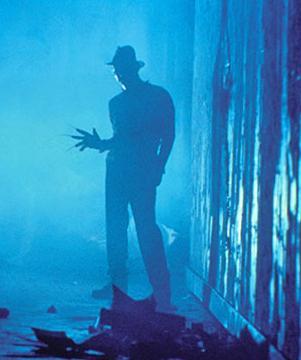 I became obsessed with Freddy Krueger. I’m not sure what prompted it. I know I had a sleepover with about three friends and watched both the original Friday the 13th (unimpressive) and A Nightmare on Elm Street (flaw-free). I wasn’t the same after that.
Constant high school visits to Six Flags: Fright Fest involved wandering around with a friend, calling out for Freddy and then when a worker dressed in the fedora, red and green sweater and knifed gloves appeared, we giggled madly as if we had just run into a Backstreet Boy. We were weird teenagers.
But I didn’t care! I loved everything about this movie: the atmosphere, the teenagers, the Final Girl, the murders and of course, Freddy Krueger. It’s still my favorite slasher movie and therefore, a Halloween staple.
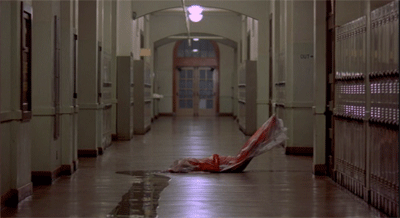 Freddy Krueger, at this point, is so ingrained in pop culture as a wisecracking smartass, it’s easy to forget that in his very first appearance, he was essentially a grim, decidedly unfunny, shadowy nightmare. There are no clear shots of Freddy and rather than being a straight slasher film, the murders occur in nightmarish dream sequences, the best of which is the reappearance of the first victim, Tina, in a body bag in a high school hallway.
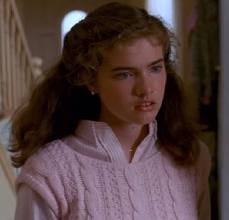 Nancy, played by Heather Langenkamp, is one of the strongest, if not the strongest, Final Girl to ever outwit the killer in a slasher movie. According to Carol J. Clover, in her somewhat dated but still worth checking out book Men, Women and Chainsaws: Gender in the Modern Horror Film, the Final Girl is masculine (in an effort for the typically male audience to identify with her) and possesses an “active investigating gaze†(48). Nancy, though she does shun sexual activity (sex = death) and reads a survivalist book to beat Freddy, she is still feminine. She’s identifiable, intelligent and determined to win. She’s a great heroine and Langenkamp deserves a great deal of praise. She recently created the documentary, I Am Nancy, which explores why Freddy became a beloved character while Nancy, the hero, was thrust into the background. My theory? Simply sexism. The wisecracking male serial killer is more interesting to the general public than the intelligent, levelheaded female would-be victim. When I was fifteen, I was guilty of this too. Now, I have a newly found appreciation for Nancy and an intense desire to see this film.
Until I get a hold of it, I just have the first and third Nightmare on Elm Street films, the best of the series, for this Halloween. Don’t fall asleep!
TDF Pamela
I’m not much of a horror movie fan. I love creepy books and I really dig movies with a lot of psychological fear involved, but what puts me off of most horror film is the gore. To say I dislike gory movies is a terrible understatement. I frigging hate slasher flicks and torture porn. For me, being grossed out is not the same as being scared. I like to jump out of my skin, but I really don’t like having to cover my eyes because someone’s guts are being ripped out. (I can tolerate bloody movies, but the moment guts are involved, the deal is off.)
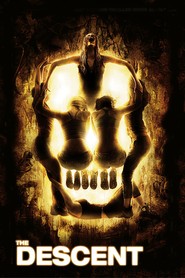 So when my fiancé and I combined our movie collections, I balked when I saw that he has a copy of The Descent. I didn’t know much about the movie, just that it involved a group of women, a cave, and all kinds of scary shit. I let him talk me into watching it, though, after getting his solemn oath that the movie was not a slasher gore-fest.
Imagine my surprise when I ended up really liking it. Beware spoilers for The Descent!
The Descent is about six women who reunite a year after a terrible car accident took the lives of one woman’s husband and daughter. They head into the Appalachian wilderness to go cave exploring, but things begin to go horribly wrong after a tunnel collapse traps them in a cave network that’s inhabited by something that’s decidedly not human.
One thing I liked about The Descent is how quiet it is. I don’t mean quiet as in volume, but rather the low-key way that the actors and the director approached the subject matter. I’m rather claustrophobic, so even the basic premise of this movie is nightmarish for me. When fear and claustrophobia start to affect the characters, I was right there with them, and I appreciate that their psychological breakdowns weren’t particularly melodramatic. Each woman slipped down that slope at her own pace, some of them holding onto sanity until the end while others started to freak out early on.
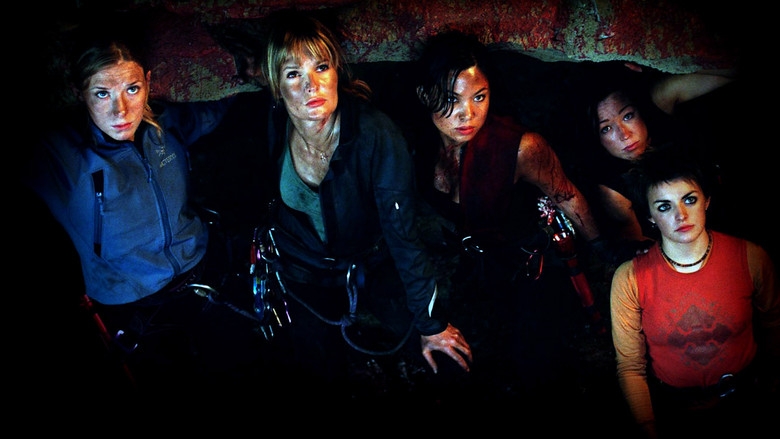
Another thing that I liked is that all of the major characters are women. In most of the horror movies I’ve watched, women tend to occupy a couple of well-defined roles: the slutty victim or the Final Girl (which Kerry discussed above). None of the characters in The Descent were sacrificial sluts or virginal heroines who escape thanks to their virtue. We admittedly don’t get much background on more than two or three characters in The Descent, but each character had her own particular feel and personality, and you get attached to them. It’s not a movie where you’re looking for the next creative way for someone to die. It’s a movie where you’re genuinely afraid for the characters and are affected by their deaths.
I don’t think The Descent is particularly gory, but it is bloody. There are some gory scenes, but it was within my tolerance level. The effing scariest parts for me were toward the beginning, just after they realize that they’re trapped and that Juno, their guide, has taken them into an unexplored cave instead of the nice, familiar, mapped cave system they thought they were going into. It’s dark and dangerous, and Sarah (the woman who lost her family and still hasn’t quite gotten over it yet) thinks she sees something out there in the dark. Between the paranoid fear and the physical danger they’re constantly in, I was a ball of nerves.
Which brings me to my main criticism of The Descent. I really wish they hadn’t shown the slimy, cannibalistic baddies so early in the film. Or better yet, I wish the slimy, cannibalistic baddies weren’t even in the film. I think it could have been so much scarier if it had veered away from the traditional horror monster route and had just played upon the psychological breakdown of the characters. Hallucinations and paranoia could have been more effective in creeping me the hell out. The cannibal creatures were gross and scary, to be certain, but this goes back to my preference for psychological horror. I’d rather see the women all slowly lose their minds and turn on each other (which happens to an extent) rather than fight against an actual monster.
But even with that complaint, I thought the movie was very creepy and really nicely made. The use of light was particularly good. Many movies that are supposed to take place in the dark look too well-lit. I know you have to see the actors, but at the same time, it’s just not as creepy when you can see everything around you in a cave. For the most part, The Descent is extremely dark, and you only see what the characters can see in their immediate surroundings. You can tell it’s on a shoestring budget, but it’s not bothersome. The simplicity of it actually works quite well.
Seriously, there are big spoilers for the end of the movie after this point.
And finally, let’s talk about my favorite part of the movie: the ending. When the movie was released in American theatres, the ending was trimmed, so if you’ve only seen the American theatrical version, you’re missing out. The unrated DVD version has the original British ending, and I think it was brilliant. In the American version, you see Sarah claw her way out of the cave after crippling and abandoning Juno to the monsters. She runs to her car and drives for a while, then pulls over to get sick and sits up to see a blood-streaked Juno sitting in the car at her side.
In the British ending, you find out that her escape is just a dream. At various points in the movie when Sarah is under extreme stress, she sees a birthday cake in the darkness, perhaps a memory of her dead daughter’s last party. After the shock of seeing Juno in the car, we’re back in the cave. Sarah is kneeling, reaching toward the hallucination of the birthday cake and her daughter, and the camera pulls back to show us that she’s still trapped underground. She’s lost her sanity, and you can pretty much bet that there’s no hope for her to escape the cave.
[youtube http://www.youtube.com/watch?v=_jf_-vwIrsQ]
It’s bleak. But the bleakness is what I like so much about it. The American cut ending plays into our expectations. She’s escaped, and even though there are still nightmarish things going on, she’s at least out of the cave. I like having my expectations fucked with, though, and by having that escape as a dream or a hallucination, we get a little taste of what we expect to happen only to have it snatched away. I loved that. Absolutely loved it.

Follow Us!