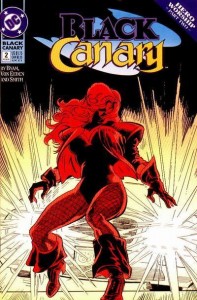
Cover by Trevor von Eeden
Writer: Sarah E. Byam
Penciller: Trevor von Eeden
Inker: Bob Smith
Letterer: Steve Haynie
Colorist: Julia Lacquement
Black Canary was one of my favorite discoveries while watching Justice League Unlimited and I have been sadly bereft of Black Canary-centered comics. All of my previous experience with Black Canary featured her in a group or couple setting. She was either an important member of the Birds of Prey or the serious, rock steady girlfriend of Green Arrow. She was never particularly funny but she definitely played the “straight man” role a lot of the time. Therefore, I was surprised by how gritty this issue was. Byam emphasized the serious ramifications of being a superhero for Black Canary; she was troubled, not averse to violence and extremely serious about the job at hand. I liked it.
I’m still not sure how I feel about the way in which gender was handled in this issue. A part of me found it refreshing that Dinah was very much aware of her gender and yet did not dwell on a sense of Otherness. Yet I was also concerned by the very same fact that she DID draw attention to her identity as female. As a feminist comic book fan, I am still struggling with my own understandings of what it means to be equal or even taken seriously and also be female in comic book worlds. Does equality = gender neutrality; a complete lack of attention paid to gender differences? Or, is it in fact found in an emphasis on difference and a corresponding empowerment through this? In other words, should Wonder Woman celebrate the fact that she is a woman or simply ignore it and get the job done?
This is an issue that has plagued feminists for many, many years and we are no closer to an universal answer. If anything, the only answer we can seem to agree one is that there is no one correct way to achieve equality or be a feminist. What I find empowering, another woman may find demeaning and that’s all right. The important thing is that we have the choice to decide these things for ourselves.
It’s also difficult simply because in comic books, gender is so intrinsically linked to identity. Look at the titles bestowed upon our heroes: Iron Man, Batgirl, The Huntress, She-Hulk, Superman. Gendered binaries are unavoidable in comic books. Of course, there are awesome characters that have completely neutral names and therefore, the titles can be taken on by multiple characters of different genders (the Question and even Robin in The Dark Knight Returns immediately come to mind).
Black Canary, however, will probably always be a woman because of the feminizing implications of the word “canary”. It’s a girly bird, apparently, unlike Hawkeye; who, interestingly enough, was also portrayed by a woman, which then begs the question: is it more acceptable for a woman to emulate a man than for a man to emulate a woman?
What was especially interesting about this issue had nothing to do with the story itself. The fan letters at the end of the book were all focused on Black Canary’s role as a female superhero. Each letter, at one point or another either praised DC for diversifying its heroes and giving more women their own books or lambasted DC for its ham-fisted representation of a woman. Also, one letter called Black Canary a “Rambitch.” I’m not sure what that is but the responding letter from DC told me I should be offended. It should also be noted that every single letter was written by a man.
Furthermore, many of them commented on how great it is that more female characters are getting noticed and their time in the sun by DC. This sounded vaguely familiar to me, and then I remembered that I have read the same sort of comments on multiple comic book blogs and articles. Seriously, this comic is 18 years old, and we still haven’t gotten over our own congratulatory amazement that female comic book characters can be taken seriously and also just be plain awesome.
It seems that no matter what, we just can’t move on from the mere fact that female comic book characters EXIST.









Follow Us!