
Say hello to Kerry, a guest contributor here at TDF! She’s graciously shared this awesome essay about witchcraft in Thor: The Dark World, and we’re happy to have her! -Pamela
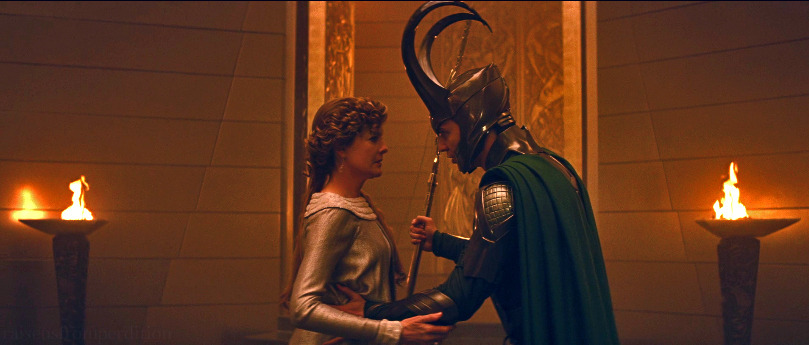
Frigga (Rene Russo) and Loki (Tom Hiddleston) in Marvel’s Thor (2011)
WARNING: SPOILERS AHEAD
The Frigga and Loki of the Marvel Cinematic Universe (MCU) have always seemed to have a bittersweet yet loving relationship. Well before the release of Marvel’s Thor: The Dark World, fandom was on board with the fact that aside from Thor, Frigga was the only member of the Asgardian royal family that Loki truly loved. Furthermore, Frigga seemed to be the only one who loved and understood her youngest son the most. At least, that’s what countless works of fanart and fanfiction claimed.
Later, at Disney’s D23 Expo this summer, Tom Hiddleston (Loki) articulated what had already been accepted as fanon in a quote that, since the release of Thor: The Dark World, has been reblogged all over the place:
Rene Russo [Frigga] and I, always, from the very first film, part of the backstory we created was that Frigga was really the most attentive to Loki when he was a child. And Odin didn’t really know how to connect. He connected much more with Thor. They were sort of cut from the same cloth. And Frigga and Loki had this kind of beautiful, sensitive, more artistic relationship. And it was actually her who taught him all his magic. (source: HitFix)
Ok, so now it’s canon that while Odin seemed to focus on Thor, Loki was the apple of Mama Frigga’s eye. But why? What does this mean? And where did this fanon-now-canon idea come from?

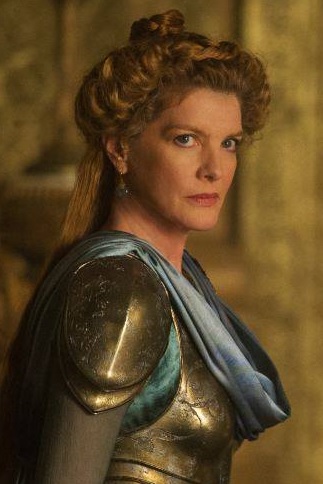
Frigga (Rene Russo) in Marvel’s Thor: The Dark World (2013)
For starters, it’s important to note that magic is at the forefront of their relationship, especially in Thor: The Dark World. Let’s look at that quote Tom said above. He equates beauty and sensitivity to Loki and Frigga’s relationship and immediately follows it up with her imparting wisdom in the form of magic to her son. Whether or not he was aware of it, Tom was using very gendered terms to describe their mother/son relationship. Beauty and sensitivity, according to our society, typically belong in the realm of the feminine. So, too, does magic.
There was a moment in Thor: The Dark World in which Frigga tricks Malekith, causing him to exclaim, “WITCH.” This moment was surprising in that Malekith used the term “witch” as an insult. I think what surprised me the most was the fact that Malekith, for being a dark elf, isn’t much different than a human. After all, to be labeled a witch is to be labeled cruel, nasty, tormenting, and just plain mean here on Midgard, too. Furthermore, it is a distinctly gendered term. Witch = feminine.
If we look at the Dictionary of Symbolism, “countless …peoples have believed in witches and in the demonic powers of certain women whom they have characterized as cannibals, sorceresses, murderesses…” (386). Even Harry Potter refrained from using witch as a unisex term. Witchery belongs to women only and therefore, according to neurotic and phallocentric patriarchy, must be feared and destroyed (yet, ironically, it is also weak as magic is no match for traditionally male-run science but that’s another discussion). Many of the symbols we equate with witchcraft are therefore feminine, such as broomsticks, potent sexuality, and cats. I mention cats because it is interesting to note that along with being the preferred pet of witches, the Norse goddess Freyja, who had a connection with Frigg, wife of Odin, traveled with a chariot drawn by cats, as explained by Kevin Crossley-Holland in his awesome text, The Norse Myths (xxx).
Yet witches, by tradition and by modern reclamation of the term by feminists, are highly complex and wise creatures. After all, Frigga did not flinch or take offense at Malekith’s use of the term. Witches (and therefore magic) have the power to demonstrate “wisdom beyond knowledge” (Biedermann 227). In the MCU, Frigga is the only Asgardian royal who sees things clearly. In a deleted scene from Marvel’s Thor (2011), Frigga claims that she had asked Odin to be honest to Loki about his parentage from the beginning. Which, to be frank, would have saved everyone a whole mess of trouble. But Odin, with his stubbornness and convenient Odinsleeps, didn’t listen and we see the handiwork of male pride throughout the film.
Going back to Frigga and Loki’s relationship, we can infer that she not only bestowed unconditional love but wisdom to her youngest son. It’s implied repeatedly that Loki is the cleverer of her two boys (Thor is intelligent in vastly different and important ways so don’t worry; I firmly believe that Thor is NOT a dumb blond). In Norse myths, after all, he was also known as the Sly One (Crossley-Holland 247). In a superficial reading of the two characters, the cliché of brains versus brawn is manifested in Thor and Loki’s relationship in the MCU.
What’s more, while he may not be emotionally wise, Loki is usually very much aware of what is going on around him. By being a “trickster,” it’s implied that Loki is typically one step ahead of everyone else, or at least he fancies himself to be. Wisdom through magic, through femininity, seems to be Loki’s stronghold. He was taught magic by his mother and then cultivated a distinctly unmasculine (as least by Asgardian standards) form of expression. Not only did she share magic with Loki, but the Frigg of the Norse myths (who was NOT Loki’s adopted mother. Loki instead was Odin’s foster-brother [Crossley-Holland xxix]) even shares shape-shifting with Loki by lending him her powerful shape-shifting falcon skin (Crossley-Holland 127). Even in the mythology these two figures relate to one another through the use of magic.
When combining magic and witchcraft with trickery, however, you no longer have wisdom but something much more dangerous and gender ambivalent. Crossley-Holland references H.R. Ellis Davidson’s description of the trickster, who points out that, “the trickster is greedy, selfish, and treacherous .… He can take on both male and female form, and can give birth to children. He is, in fact, a kind of semi-comic shaman, half way between god and hero, yet with a dash of the jester element … thrown in” (xxxix). Loki, in the Marvel comics universe, has a history of gender fluidity and will continue to do so in the upcoming Agent of Asgard comic book series.
I also found the above to be a rather apt description of Loki in Thor: The Dark World. He was dangerous, untrustworthy, and darkly funny. He even drew attention to and mocked his apparent dependence on magic when he declared, “Ta-da” after performing a particularly harrowing act. When given to Loki, magic is morphed into something darker than wisdom, something that clashes even against Frigga’s maternal love.
Turning back to the myths, Crossley-Holland points out (in a paragraph that echoes the Tumblr tags of a fangirl, myself included):
Loki embodies the ambiguous and darkening relationship between the gods and the [Frost] giants. He is dynamic and unpredictable and because of that he is both the catalyst in many of the myths and the most fascinating character in the entire mythology. Without the exciting, unstable, flawed figure of Loki, there would be no change in the fixed orders of things, no quickening pulse…. (xxix)
He is the villain and therefore the fascinating catalyst of Marvel’s The Avengers and to most fans, without Loki, the MCU would be a vastly different and boring place. Do we thank Frigga for molding Loki into the sly, dangerous, and strangely appealing character we have today? After all, the one time Loki appeared totally genuine was upon learning of Frigga’s death, which he reacted to with a violent display of magic.
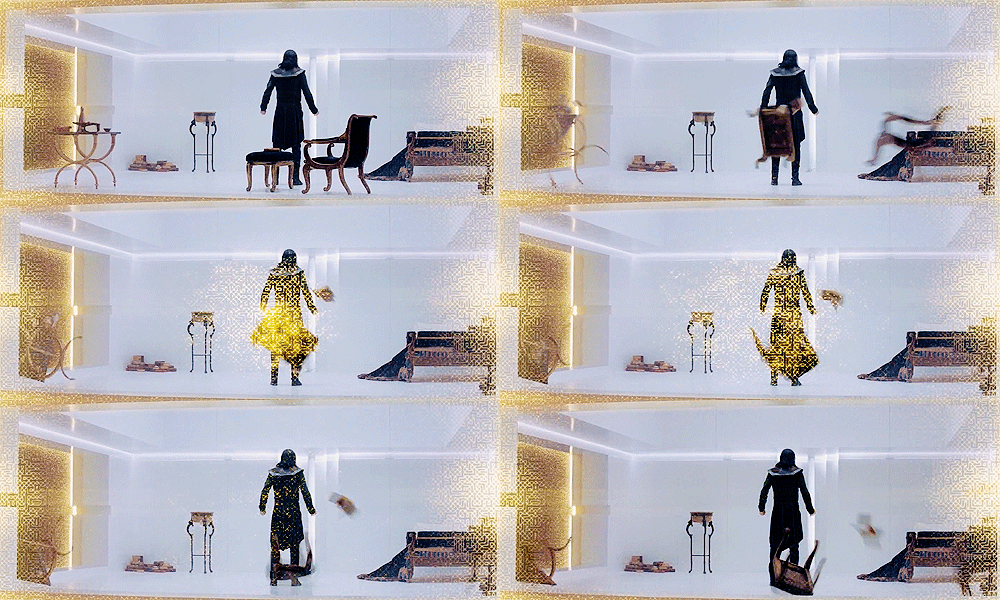
Are we to infer that Loki is still, from Norse mythology to contemporary Hollywood, a gender fluid witch whose power lives in the feminine rather than the masculine realm? Is this all thanks to Frigga (as I’m sure Freud would say) or due to his intrinsically dual nature as the son of two worlds? Does that make him a lesser villain (after all, patriarchy claims that the feminine is weaker than the masculine) against Thor or is the entire point of his existence the belief that by using the feminine to his advantage, Loki is a truly dangerous villain against the hyper-masculine Asgardians? He and Frigga, as pointed out by countless fans upon the release of the film trailers, even physically fight in the same style.
We don’t have a reason why Frigga bestowed on Loki the use of magic and more in the MCU. I doubt it was because she envisioned and desired the end result of Thor: The Dark World. It’s obvious that she loved both her sons and her husband but what did Frigga see in Loki that compelled her to reach out to him in ways so contrastingly different from Thor? And what was it about this rather quiet relationship in the MCU that made us, the fans, see it so clearly from the beginning?
Notes:






Pingback: Loki and the Language of Sexual Violence in the MCU | The Geekiary()